
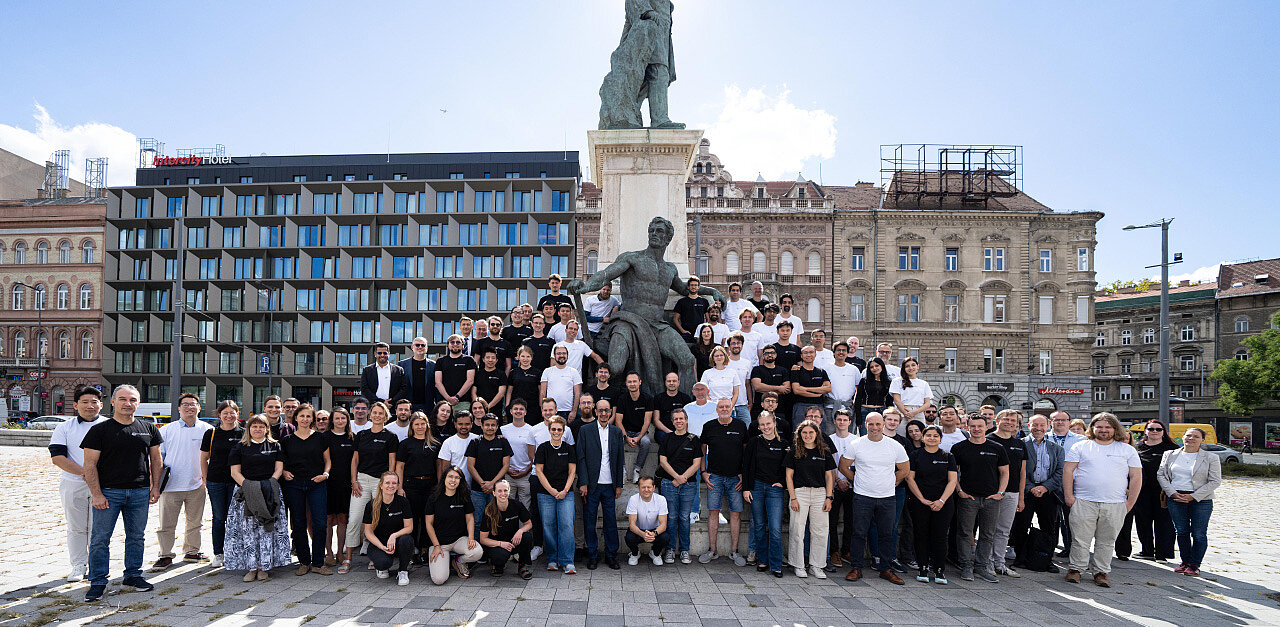
This year’s attoworld-retreat kicked off in Hungary on September 21, bringing together researchers from across the attoworld-community. The scientific program started in Budapest, where the teams shared their latest results and ideas. The talks spanned laser technology, attosecond spectroscopy and theory, field-resolved spectroscopy, molecular fingerprinting and data science. CMF, the Center for Molecular Fingerprinting, presented recent developments and progress in the H4H study in Hungary. Together with the Lasers4Life study in Germany, these efforts contribute to the broader vision of protecting.health and its goal of advancing disease prevention and early detection. Similar activities in Hong Kong and Ghana are currently being prepared.
Science did not stop at the conference room door. Posters sparked further discussions, conversations continued over dinner, and a boat trip on the Danube took participants past the illuminated Parliament, Chain Bridge and the city’s riverfront. It was a chance to exchange ideas beyond the individual research groups and, for some hours, to experience Budapest from a different perspective.
The setting also provided an unusual encounter with Hungary’s history. For the group photo, the attoworld-team gathered at the feet of Gábor Baross in front of Keleti railway station. Known as the “Iron Minister”, Baross helped transform Hungary’s transport system in the late nineteenth century, driven by the idea that better connections and greater mobility were essential to the country’s future. More than a century later, his monument made a fitting backdrop for a gathering looking towards the future in a very different field.
That thought resurfaced in Ferenc Krausz’s concluding remarks. He recalled another outstanding Hungarian, John von Neumann, whose work helped lay the foundations of modern computing. Against the background of the retreat’s discussions on artificial intelligence and its growing role in research, Krausz emphasized that human creativity, curiosity and the ability to envision what does not yet exist remain essential to scientific progress. From Budapest, the retreat moved on to Lake Balaton, where a more relaxed program offered time for personal exchange and team activities.
A special thank you goes to Kerstin Schmidt-Buchmann for leading the organization of this year’s retreat, as well as to Ruth Göttler, Sibylle Graf and everyone who contributed to the planning and organization and helped make these days in Hungary possible.
Picture: Thorsten Naeser
More


