
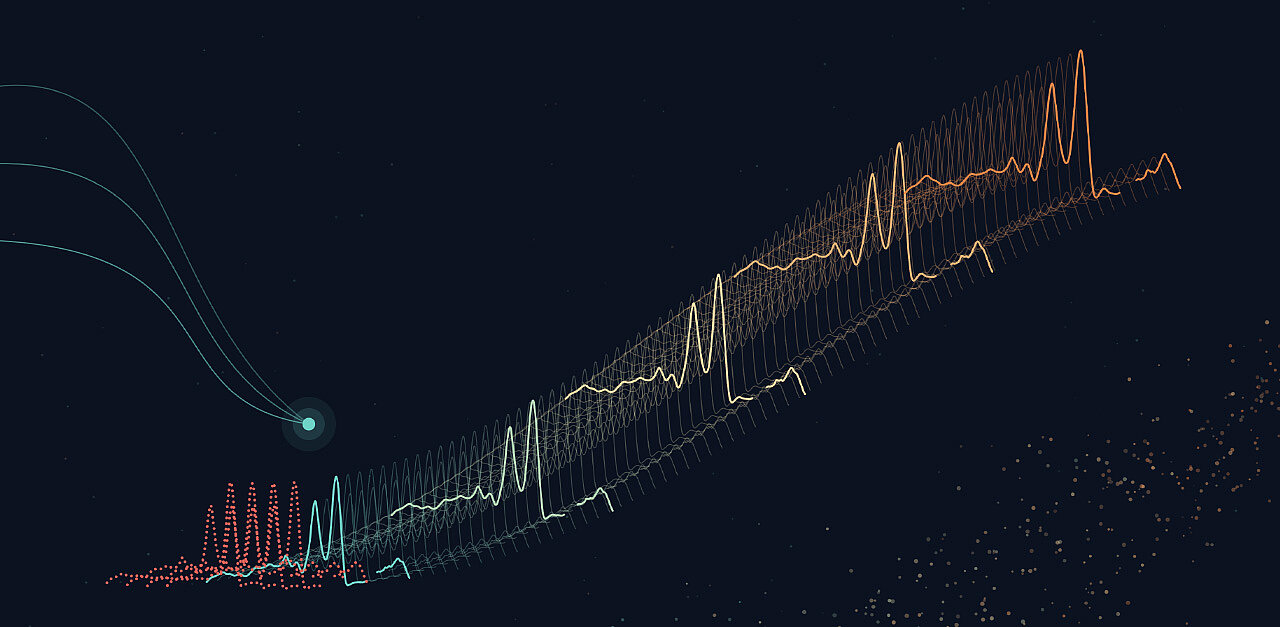
A new study of the data science group in npj Digital Medicine shows how conditional generative models can create realistic “virtual” blood fingerprints. These models let the scientists run controlled in-silico experiments that real-world data alone cannot support.
Infrared molecular fingerprints (IMFs) of blood plasma give a broad, minimally invasive snapshot of human physiology. Like any cohort-based approach, however, it is limited by the data that can be collected. Follow-up periods are finite, some demographic and phenotypic groups are underrepresented, and many scientifically interesting scenarios can never be observed directly.
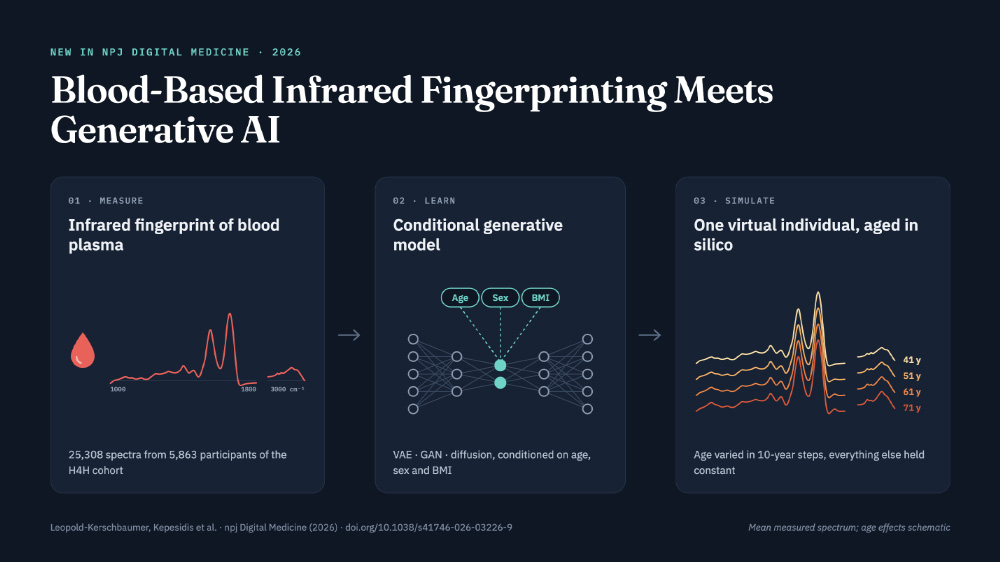
In a study led by Niklas Leopold-Kerschbaumer and Kosmas Kepesidis, the team addressed this with conditional deep generative modeling. The group trained three types of generative models on 25,308 blood-based infrared spectra from 5,863 participants in the longitudinal Health4Hungary – Hungary4Health (H4H) cohort: a variational autoencoder, a generative adversarial network, and a diffusion model. The models generate realistic synthetic spectra for specified values of age, sex and body mass index (BMI).
The synthetic spectra closely matched real measurements. This is true for individual wavenumbers, for biochemically meaningful peak ratios and for full distributions. They also carried the right demographic information. Classifiers trained only on synthetic data from the diffusion model performed as well on real spectra as classifiers trained on real data.
More than data augmentation
The main point of the work is what conditioning makes possible. Because each synthetic spectrum is tied to defined characteristics, we can treat it as coming from a “virtual individual.” The team could then change one factor at a time while holding everything else constant. This turns generative AI from a tool for producing more data into a tool for asking questions.
Healthy aging is a clear example. From real IMFs, a person's age can be estimated only to within about six years. The longitudinal trajectories in the dataset span only about two and a half years per person. Within-person changes from healthy aging over that period are therefore too small to resolve directly in the measured spectra.
Conditional generative modeling gets around this limitation. We encoded an individual’s baseline spectrum and then systematically shifted the age condition in ten-year steps. This produced spectra for the same underlying phenotype at different ages. The simulated trajectories followed the aging trends seen across the whole cohort, and they stayed within each person’s own characteristic spectral signature. This amounts to a controlled in-silico aging experiment that the observed data alone could not support.
The same principle helps with imbalanced data. Adding generated spectra for underrepresented BMI groups partly restored classification performance that had collapsed when those groups were scarce.
Next steps include adding clinical laboratory parameters to the conditioning, applying the models across instruments after spectral harmonization, and moving from conditional to causal generative modeling. Causal models would allow true “what-if” questions, such as how lifestyle or medication changes might affect a person’s molecular fingerprint.
Original publication:
conditional deep generative modeling of blood-based infrared spectra enables controlled in-silico phenotyping studies
N. Leopold-Kerschbaumer, T. Halenke, S. Süzeroğlu et al.
npj Digital Medicine (2026)
https://doi.org/10.1038/s41746-026-03226-9
Picture: Kosmas Kepesidis (AI-generated)
More


